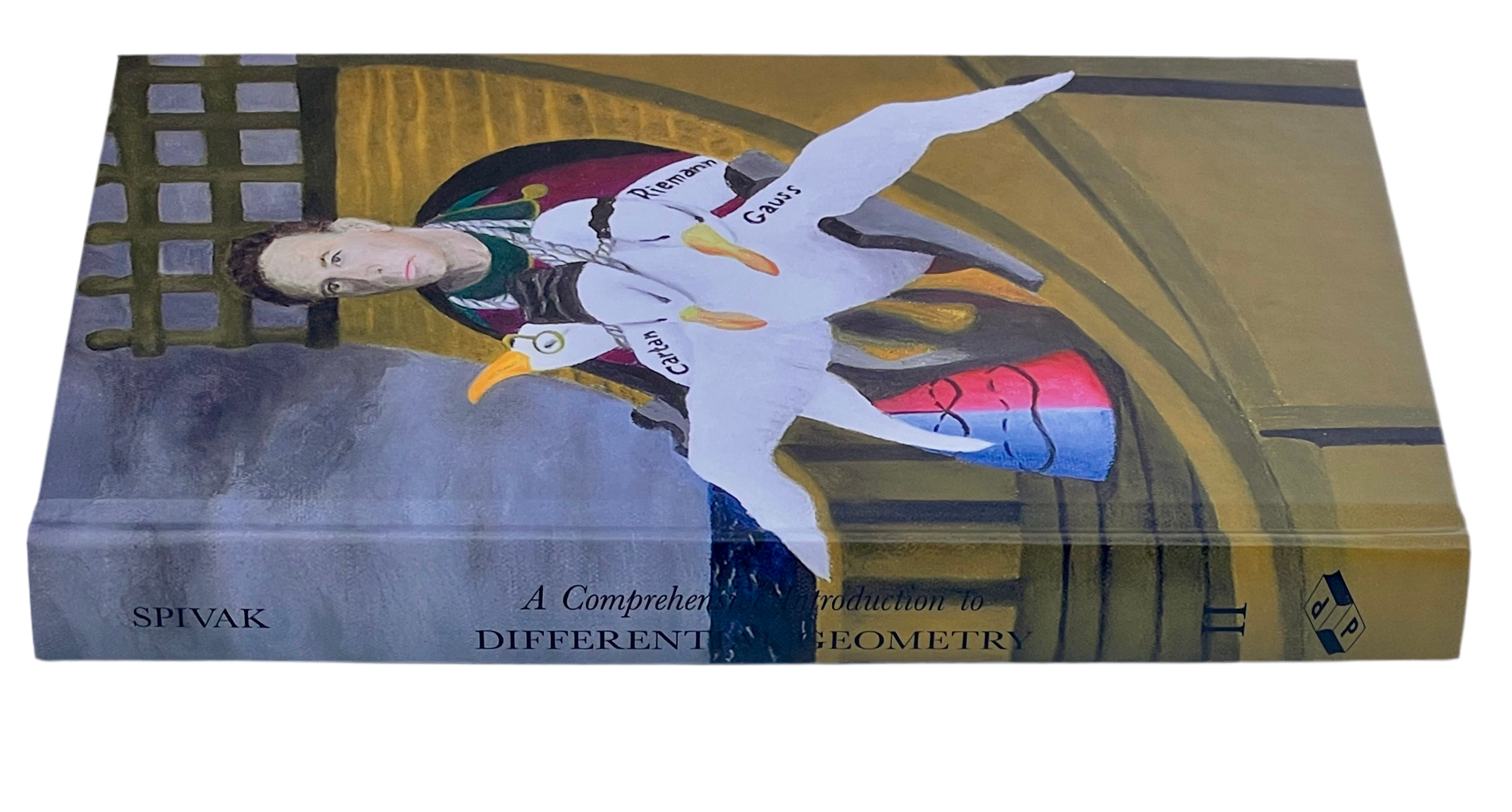
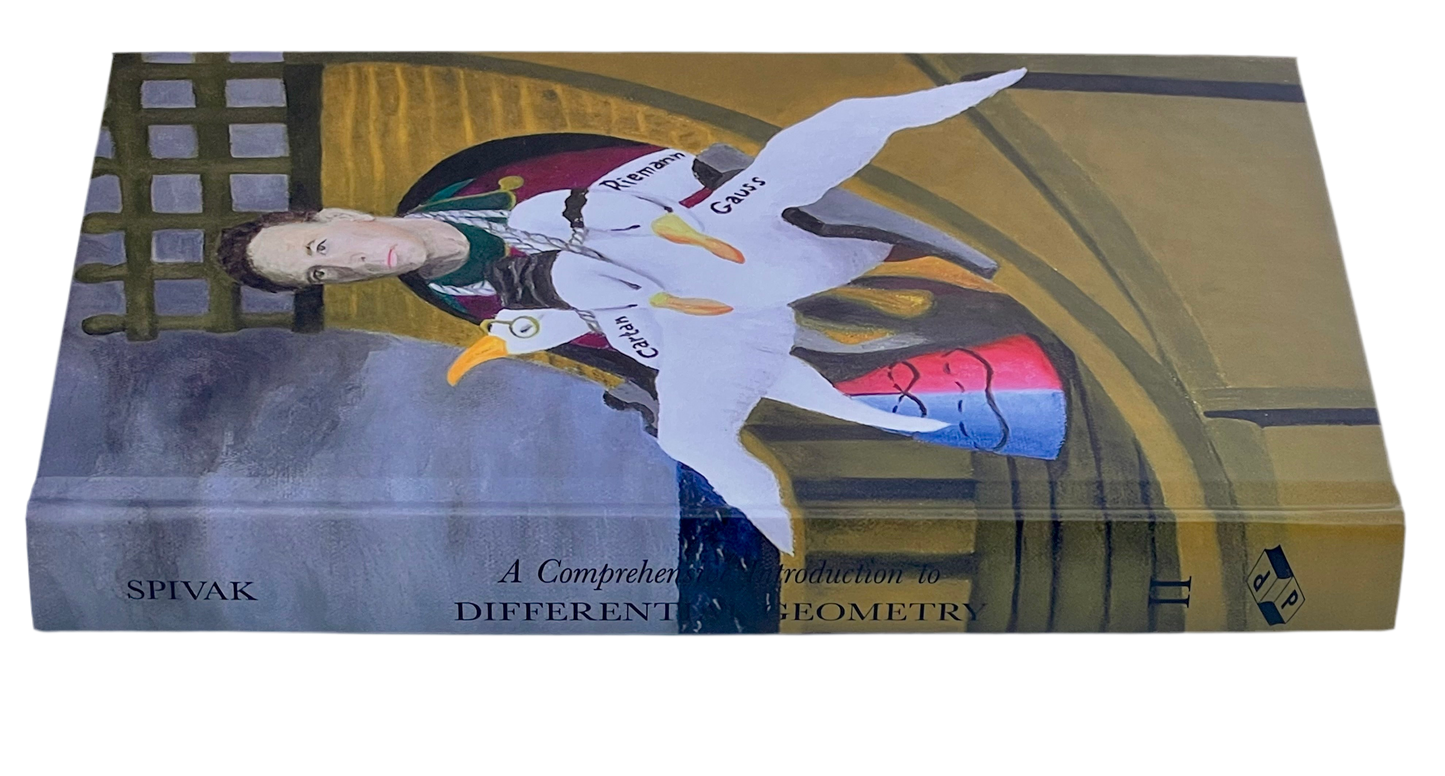
A Comprehensive Introduction to Differential Geometry, Volume Two, Third Edition by Michael Spivak is where the geometry begins in earnest — available here direct from Publish or Perish, Inc., the official publisher.
If Volume One established the modern language of differentiable manifolds, Volume Two puts that language to work. Beginning with the simplest geometric objects — curves in the plane and in space — it follows the semi-historical path promised in the first volume, moving through the classical surface theory of Euler and Gauss, the foundational papers of Riemann, and the development of curvature theory in its modern form. The most decisive encounters with classical differential geometry are here, in Chapters 3 and 4, where Gauss and Riemann are read on their own terms.
About This Volume
Spivak noted in the preface that this volume begins the study of modern differential geometry in earnest. It follows the historical path laid out in Volume One — not as a history lesson, but as the most illuminating way to understand where the concepts came from and why they take the forms they do. Chapter 3 presents Gauss' theory of surfaces directly, including a guide to reading Gauss himself. Chapter 4 does the same for Riemann, including a treatment of his inaugural lecture and the birth of the Riemann curvature tensor. Spivak's view was that skipping these classical encounters misses all the fun.
There are no problem sets in this volume — the material does not easily lend itself to them. The final volume of the series contains a comprehensive bibliography of the differential geometry literature, including texts where problems may be found.
What This Volume Covers
See the complete table of contents for Volume 2 — every chapter and section heading.
-
Chapter 1 — Curves in the Plane and in Space: Curvature of plane curves, convex curves, curvature and torsion of space curves, the Serret-Frenet formulas, the natural form on a Lie group, and classification of curves under affine motions.
-
Chapter 2 — What They Knew About Surfaces Before Gauss: Euler's Theorem and Meusnier's Theorem — the state of surface theory before Gauss transformed it.
-
Chapter 3 — The Curvature of Surfaces in Space: A guide to reading Gauss, followed by Gauss' full theory of surfaces — the Gauss map, Gaussian curvature, the Weingarten map, the first and second fundamental forms, the Theorema Egregium, geodesics, and the integral of curvature over a geodesic triangle.
-
Chapter 4 — The Curvature of Higher Dimensional Manifolds: Riemann's inaugural lecture, Riemannian normal coordinates, a prize essay, and the birth of the Riemann curvature tensor — sectional curvature and the conditions for flatness.
-
Chapter 5 — The Absolute Differential Calculus (The Ricci Calculus): Covariant derivatives, Ricci's Lemma, Ricci's identities, the curvature tensor, classical connections, the torsion tensor, geodesics, and Bianchi's identities.
-
Chapter 6 — The Nabla Operator: Koszul connections, covariant derivatives, parallel translation, the Levi-Civita connection, the curvature tensor, geodesics, and the first variation formula.
-
Chapter 7 — The Moving Frame: Moving frames, the structural equations of Euclidean space and Riemannian manifolds, adapted frames, Cartan connections, manifolds of constant curvature, Schur's theorem, and conformally equivalent manifolds.
-
Chapter 8 — Connections in Principal Bundles: Principal bundles, Lie groups acting on manifolds, Cartan connections, Ehresmann connections, parallel translation, the curvature form, structural equations, and Bianchi's identities.
Volume Two requires the foundation established in Volume One. Together, Volumes One and Two form the prerequisite for Physics for Mathematicians, Mechanics I. The complete five-volume set is also available at a 20% discount.
About This Edition
Each volume is hardcover with a matte laminate finish. The pages are printed on a premium 60lb uncoated text stock selected for its opacity, smoothness, and reading comfort. At 96 brightness with enhanced opacity, it renders mathematical notation and fine print with sharp contrast and minimal show-through. It is grain-short, meaning the paper fibers run parallel to the spine, which is why the pages turn easily and the book lies flat without being forced. Being acid-free, it will not yellow with age. Each volume is bound using PUR (Polyurethane Reactive) adhesive — a high-performance binding method that offers significantly greater page-pull strength and superior lay-flat quality compared to traditional glues, and holds reliably under heavy use.
Shipping
Free FedEx 2Day (US)
Processing
1 Business Day
Delivery
2 to 4 Days
Returns
30 Days
About the Author
Michael Spivak (1940–2020) earned his Ph.D. from Princeton University and is celebrated for writing mathematics textbooks of extraordinary rigor and clarity. A Comprehensive Introduction to Differential Geometry is his magnum opus — a five-volume work that remains the definitive treatment of the subject. He founded Publish or Perish, Inc., through which all of his major works are published.