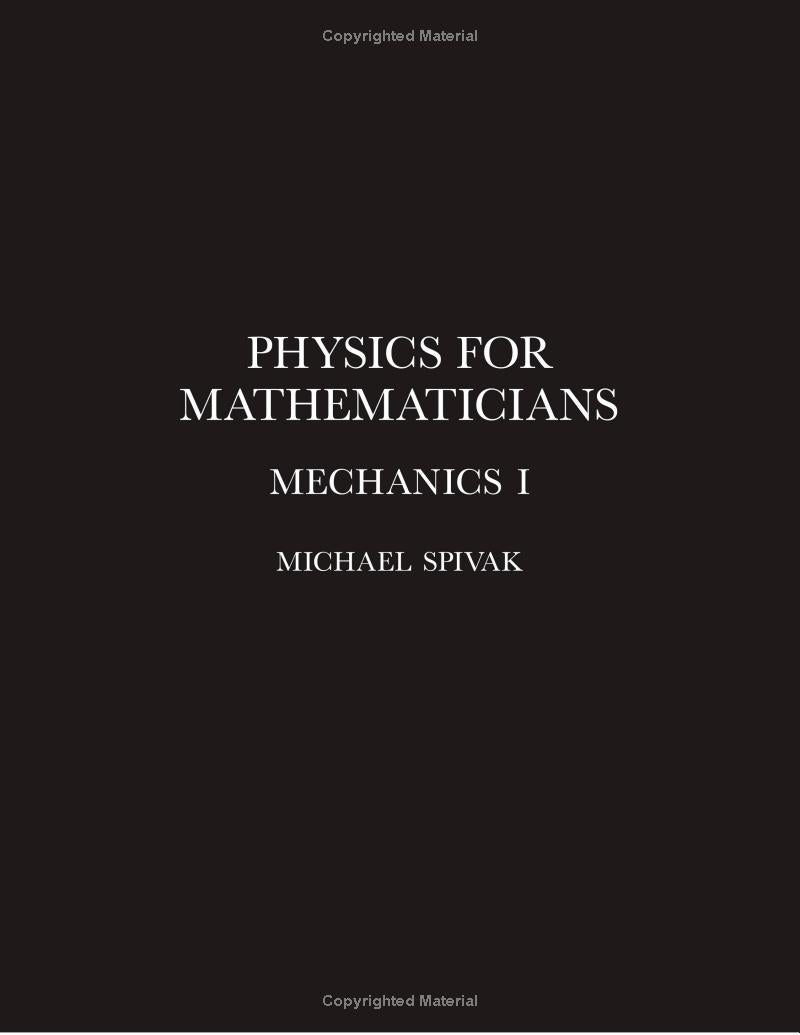
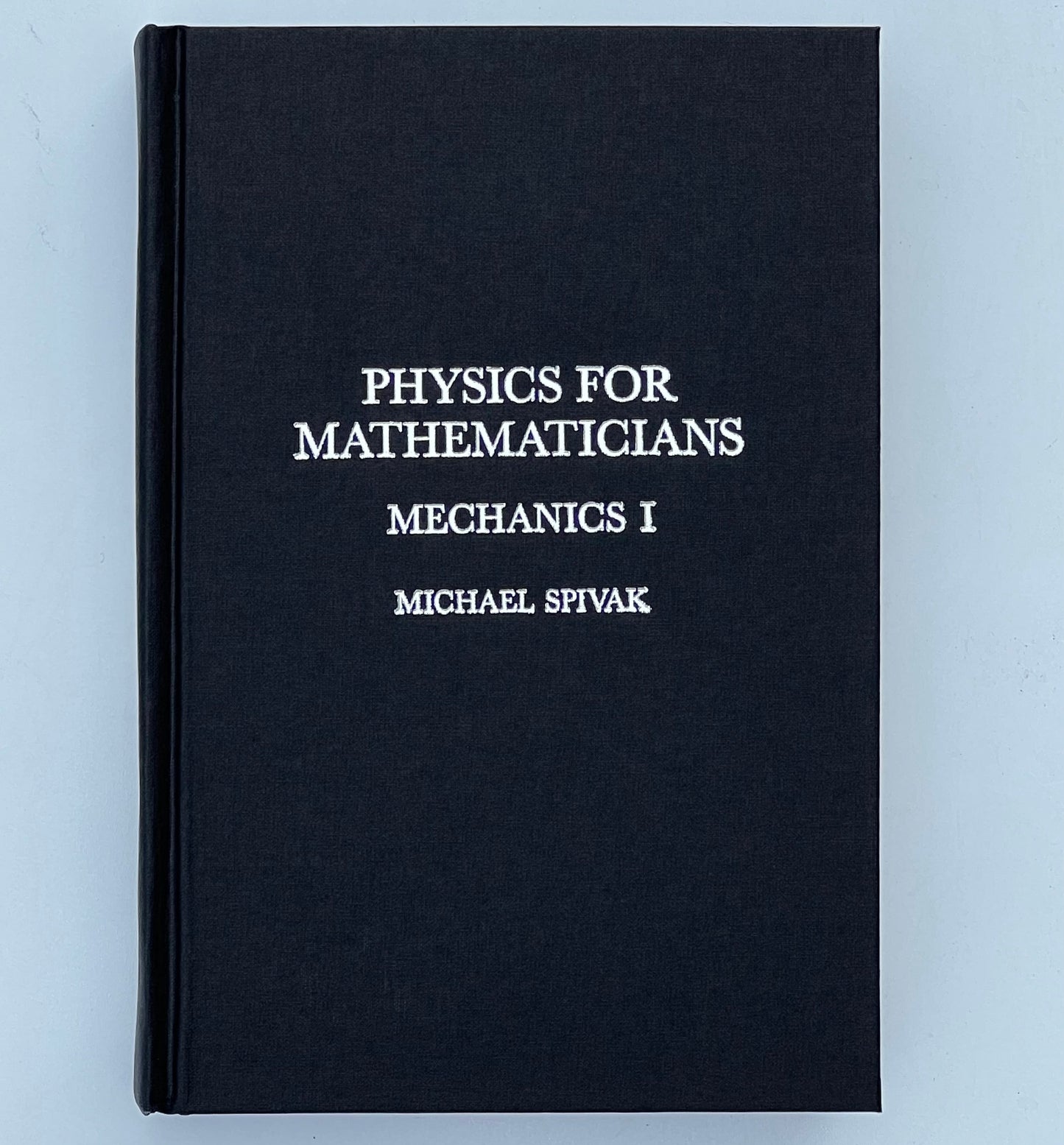
Physics for Mathematicians, Mechanics I by Michael Spivak is the definitive mathematically rigorous introduction to classical mechanics, available exclusively at mathpop.com direct from the official publisher, Publish or Perish, Inc.
In this inaugural volume of a projected series on theoretical physics, Spivak brings the same uncompromising rigor and clarity that defined his celebrated Calculus to the study of classical mechanics. Written specifically for readers with a strong foundation in pure mathematics, this text employs the tools of differential geometry to bridge abstract mathematical theory and physical principles — giving mechanics the precise, honest treatment it deserves.
Exclusive to mathpop.com
About This Edition
This edition is Smyth sewn and casebound in black cloth with silver foil stamping — a construction chosen for permanence and for the reading experience a text of this weight demands. No cornstarch has been used in the binding materials, a deliberate improvement over earlier production runs.
On the Craft of Binding
After sewing, each book is nipped using a vintage 1950s smasher — a full-pressure nipping machine that removes air from the folded signatures before the book is cased in. This step, increasingly rare in modern bookmaking, compresses the spine cleanly and can reduce its thickness by up to 1/8 inch, eliminating the nail head that forms when signatures are left un-nipped. The result is a tighter, flatter spine with the correct pressure profile at the hinge points and a book that is noticeably cleaner and more compact than earlier sewn versions of the same title.
Many binderies substitute a speed nip — a faster, lower-pressure process that approximates the result. The full nip is treated here as a point of craft. It is becoming a lost art, and the difference is visible in the finished book.
The interior pages are printed on a premium 60lb uncoated text stock selected for its combination of smoothness and reading comfort. The sheet is highly calendered — a process that compresses the paper fibers under pressure to produce an exceptionally level, uniform surface — giving it a tactile quality that is immediately noticeable. At 97 brightness it renders mathematical notation and fine print with sharp contrast and minimal show-through. Being acid-free, it will not yellow with age. It is grain-short, meaning the paper fibers run parallel to the spine, which is why the book lies flat without being forced.
About the Book
Spivak opens the preface with a precise statement of purpose: this is a book for someone trained in modern mathematics and inculcated with its general outlook. Not someone who merely uses mathematics as a tool, but someone for whom rigor and precise definitions are the natural mode of thought. The prerequisite he names is his own A Comprehensive Introduction to Differential Geometry, Volumes 1 and 2 — not because he wrote it, but because the concepts of mechanics are, in his view, best expressed in the language of differential geometry.
What he set out to understand — and what the book works through — is not just the advanced physics that mathematicians find straightforward, but the elementary physics that physicists seem to find natural and mathematicians have always found hard to fathom: the mysterious reductions by which a complicated physical problem becomes a simple mathematical question. Wheels, weights, ropes and pulleys. Where does the extra force from a lever actually come from? Why do standard physics texts answer that question so unsatisfyingly?
Spivak wrote the book, as he wrote all his books, in order to learn the subject himself in a form he could find comprehensible. The result is an account of classical mechanics that begins with Newton's laws, works carefully through the full arc of the subject, and arrives at Lagrangian and Hamiltonian mechanics — treating every step with the honesty and precision a mathematician would demand.
What the Book Covers
-
Part I — The Foundations of Mechanics: Newtonian mechanics from first principles, central forces, conservation laws, the one- and two-body problems, rigid bodies, constraints, and philosophical and historical questions about the development of the subject.
-
Part II — Building on the Foundations: Oscillations, rigid body motion, non-inertial systems and fictitious forces, and friction — including the Painleve paradoxes, billiards, and tippe tops.
-
Part III — Lagrangian Mechanics: Analytical mechanics, variational principles, Hamilton's principle, Noether's theorem, and small oscillations.
-
Part IV — Hamiltonian Mechanics: The cotangent bundle, Hamilton-Jacobi theory, canonical transformations, symplectic manifolds, Liouville integrability, and action-angle variables — concluding with adiabatic invariants and the Hannay angle.
-
Interlude — Light: A chapter on the history and mathematics of optics, tracing the interplay between mechanics and optics from antiquity through Hamilton.
-
Supplement — A PDE Primer: Supporting material on partial differential equations for readers who need it.
Shipping Free FedEx 2Day (US)
Processing 1 Business Day
Delivery 2 to 4 Days
Returns 30 Days
About the Author
Michael Spivak (1940–2020) earned his Ph.D. from Princeton University and is celebrated for writing mathematics textbooks of extraordinary rigor and clarity. In addition to Physics for Mathematicians, he authored the five-volume A Comprehensive Introduction to Differential Geometry and the landmark text Calculus. He founded Publish or Perish, Inc., through which all of his major works are published.