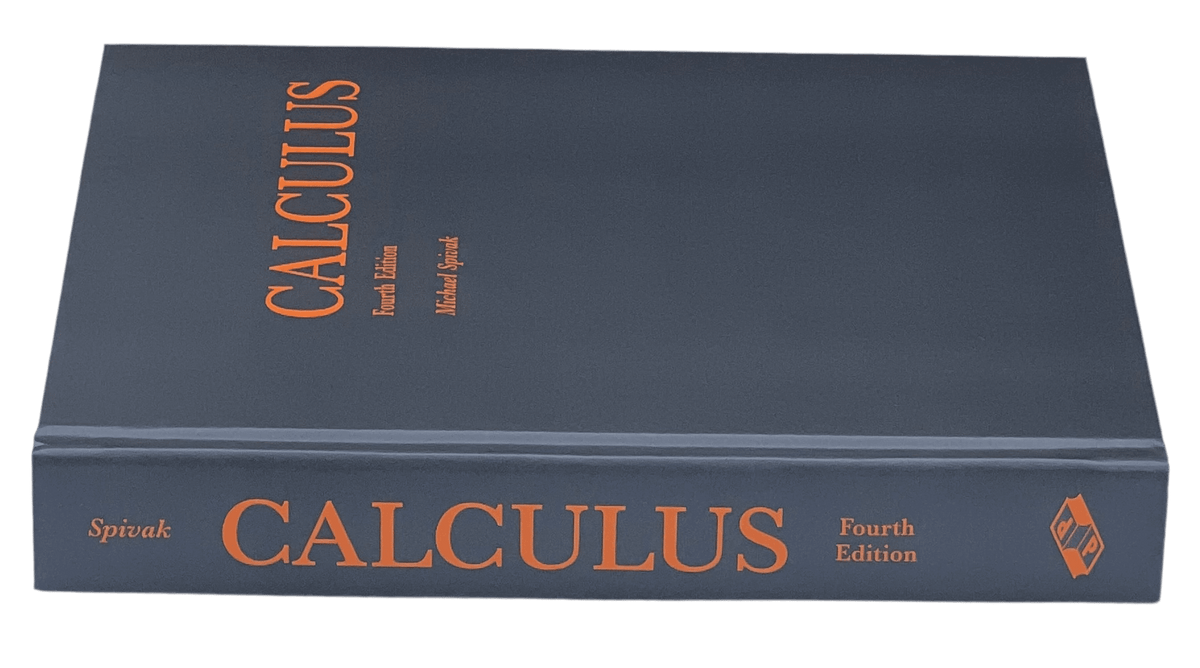
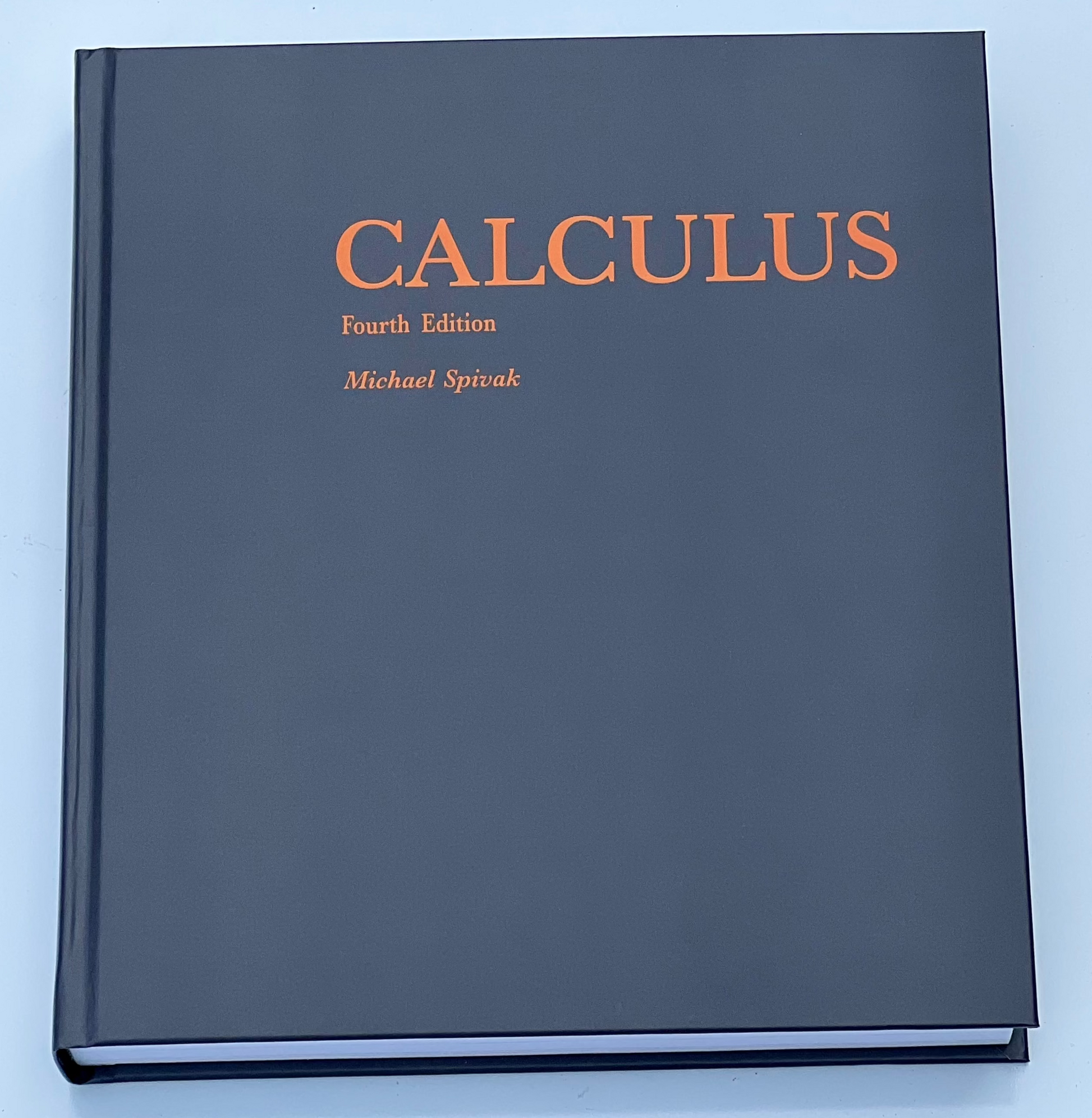
Calculus, 4th Edition by Michael Spivak is widely regarded as the finest proof-based calculus textbook ever written — available here directly from Publish or Perish, Inc., the official publisher.
Spivak wrote this book to present calculus not merely as a prelude to mathematics, but as the first real encounter with it. The foundations of analysis provided the arena in which modern mathematical thinking developed, and calculus — in his view — ought to be the place where a student expects rigor rather than avoids it. Precision is not a deterrent to intuition here, nor an end in itself, but the natural medium in which mathematical questions are formulated and thought through. The result is a book that has been in continuous use since 1967 and remains the definitive text for students who intend to take mathematics seriously.
What This Book Covers
-
Part I — Prologue
Basic Properties of Numbers; Numbers of Various Sorts. The book begins not with formulas but with the logical foundations — the properties of numbers from which everything else follows.
-
Part II — Foundations
Functions, Graphs, Limits, Continuous Functions, Three Hard Theorems, Least Upper Bounds. The rigorous foundations of analysis, developed carefully and compared throughout with geometric intuition.
-
Part III — Derivatives and Integrals
Derivatives, Differentiation, Significance of the Derivative, Inverse Functions, Integrals, the Fundamental Theorem of Calculus, Trigonometric Functions, Logarithm and Exponential Functions, Integration in Elementary Terms. The core of the calculus, built from first principles. Includes the starred chapter on planetary motion — a substantial application of calculus to physics added in the third edition.
-
Part IV — Infinite Sequences and Infinite Series
Approximation by Polynomial Functions, Infinite Sequences, Infinite Series, Uniform Convergence and Power Series, Complex Numbers, Complex Functions, Complex Power Series. The starred chapter on the transcendence of e is included for those who wish to go further.
-
Part V — Epilogue
Fields, Construction of the Real Numbers, Uniqueness of the Real Numbers. An optional concluding section for students who wish to examine on their own a rigorous construction of the real numbers — the foundation on which the entire book rests.
Why This Book
-
The first real encounter with mathematics — Spivak's stated purpose was to present calculus as the place where mathematical thinking begins, not merely a prelude to it. Every chapter reflects that aim.
-
29 chapters across five parts — comprehensive in scope, with two starred optional chapters and an epilogue on the construction of the real numbers for those who want the complete foundation.
-
Over 625 problems — ranging from foundational exercises that build technique to problems of considerable difficulty and interest. Many include hints; a separate answer book contains complete solutions.
-
The fourth and final edition — incorporating corrections and revisions accumulated over four decades, a complete update of the Suggested Reading, and additional problems of intermediate difficulty introduced with the help of Ted Shifrin.
-
The standard text for serious students — consistently recommended for honors mathematics courses and for anyone who wants to understand not just how calculus works, but why.
About This Edition
This hardcover edition is printed on a premium 50lb uncoated text stock selected for its opacity and reading comfort — acid-free, archival, and engineered to render mathematical notation with sharp contrast and minimal show-through. Each copy is bound using PUR (Polyurethane Reactive) adhesive — a high-performance binding method that offers significantly greater page-pull strength and superior lay-flat quality compared to traditional glues, and holds reliably under heavy use.
Shipping
Free FedEx 2Day (US)
Processing
1 Business Day
Delivery
2 to 4 Days
Returns
30 Days
About the Author
Michael Spivak (1940–2020) earned his Ph.D. from Princeton University and is celebrated for writing mathematics textbooks of extraordinary rigor and clarity. In addition to Calculus, he authored the five-volume A Comprehensive Introduction to Differential Geometry and Physics for Mathematicians, Mechanics I. He founded Publish or Perish, Inc., through which all of his major works are published.